0.64 x 1000
Answer: 640
Step-by-Step Breakdown
- Count the zeros in the multiplier. 1000 has exactly three zeros.
- Move the decimal point to the right. Move it three places to match the three zeros.
- Fill empty spaces with a zero placeholder.
- One jump makes it 6.4.
- Two jumps makes it 64.
- Three jumps requires adding a zero, making it 640.
347 + 259 + 4837
Answer: 5443
Step-by-Step Breakdown
- Group numbers for easier addition. Combine 347 and 259 first.
- 300 + 200 = 500
- 47 + 59 = 106
- So, 347 + 259 = 606.
- Add the result to the largest number. Add 606 to 4837.
- 4800 + 600 = 5400
- 37 + 6 = 43
- Result: 5443.
6663 minus 5554
Answer: 1109
Step-by-Step Breakdown
- Subtract column by column or find the difference.
- 6663 - 5000 = 1663
- 1663 - 500 = 1163
- 1163 - 50 = 1113
- 1113 - 4 = 1109.
( 510 + 120 ) / 3
Answer: 210
Step-by-Step Breakdown
- Solve the brackets first. 510 + 120 = 630.
- Divide the result by 3. 630 / 3.
- 600 / 3 = 200
- 30 / 3 = 10
- Total: 210.
Two sides of a right triangle are 9 cm and 12 cm. What is the length of its hypotenuse?
Answer: 15
Step-by-Step Breakdown
- Use the Pythagorean theorem: a² + b² = c²
- 9² = 81
- 12² = 144
- 81 + 144 = 225
- Find the square root of 225. √225 = 15.
- Shortcut: Recognize the 3-4-5 right triangle ratio. 9 and 12 are 3x3 and 3x4, so the hypotenuse is 3x5 = 15.
5x + 19 = 22y Find the value of y when x = 5
Answer: 2
Step-by-Step Breakdown
- Substitute the value of x into the equation. 5(5) + 19 = 22y
- 25 + 19 = 22y
- 44 = 22y
- Solve for y. y = 44 / 22 = 2.
346749 divided by 13
Answer: 26673
Step-by-Step Breakdown
- Use long division or chunking mentally.
- 13 goes into 34 two times (26), remainder 8. (First digit: 2)
- Bring down 6: 13 goes into 86 six times (78), remainder 8. (Second digit: 6)
- Bring down 7: 13 goes into 87 six times (78), remainder 9. (Third digit: 6)
- Bring down 4: 13 goes into 94 seven times (91), remainder 3. (Fourth digit: 7)
- Bring down 9: 13 goes into 39 three times (39), remainder 0. (Fifth digit: 3)
- Result: 26673.
An aircraft has 50 first class seats and 150 economy seats. What is the percentage of first class seats?
Answer: 25
Step-by-Step Breakdown
- Calculate total seats. 50 + 150 = 200 total seats.
- Find the fraction of first class seats. 50 / 200
- Simplify the fraction: 50/200 = 1/4
- Convert the fraction to a percentage. 1/4 = 25%.
What is the total weight of 101 passengers weighing 85 kg each?
Answer: 8585
Step-by-Step Breakdown
- Break down the multiplication into easier parts. 101 x 85 is the same as (100 x 85) + (1 x 85).
- 100 x 85 = 8500
- 1 x 85 = 85
- Add them together. 8500 + 85 = 8585.
Concorde flies 2400 miles in 3 hours. What is its average speed?
Answer: 800
Step-by-Step Breakdown
- Use the Speed = Distance / Time formula.
- Speed = 2400 miles / 3 hours
- 2400 / 3 = 800 mph.
Deicing fluid is mixed in a ratio of 75% glycol : 25% water. What total volume of deicing fluid can be mixed from 450 litres of glycol?
Answer: 600
Step-by-Step Breakdown
- Understand the ratio. 75% is 3/4 of the total volume.
- Therefore, 450 litres represents 3/4 of the total volume.
- Find 1/4 of the total volume. 450 / 3 = 150 litres.
- Calculate the total volume (4/4). 150 x 4 = 600 litres.
An aircraft descends 3000 feet every ten miles. How many miles will it travel while descending from 32000 feet to 11000 feet?
Answer: 70
Step-by-Step Breakdown
- Calculate total descent required. 32000 - 11000 = 21000 feet.
- Determine how many 3000-feet intervals there are. 21000 / 3000 = 7 intervals.
- Calculate the distance. Each interval takes 10 miles.
- 7 x 10 = 70 miles.
The speed of sound at sea level is 760 mph (mach = 1.0) What is the speed in mph of an aircraft flying at mach = 0.8 at sea level?
Answer: 608
Step-by-Step Breakdown
- Calculate 80% of 760.
- Find 10%: 760 / 10 = 76
- Multiply by 8: 76 x 8
- 70 x 8 = 560
- 6 x 8 = 48
- 560 + 48 = 608 mph.
An aircraft turns right from a course of 350 degrees to a course of 040 degrees. Through how many degrees does it turn to change course?
Answer: 50
Step-by-Step Breakdown
- Visualize a 360-degree compass. Turning right from 350 degrees means passing through North (360/0 degrees).
- Degrees to reach North: 360 - 350 = 10 degrees.
- Degrees to continue to 040: 40 degrees.
- Total turn: 10 + 40 = 50 degrees.
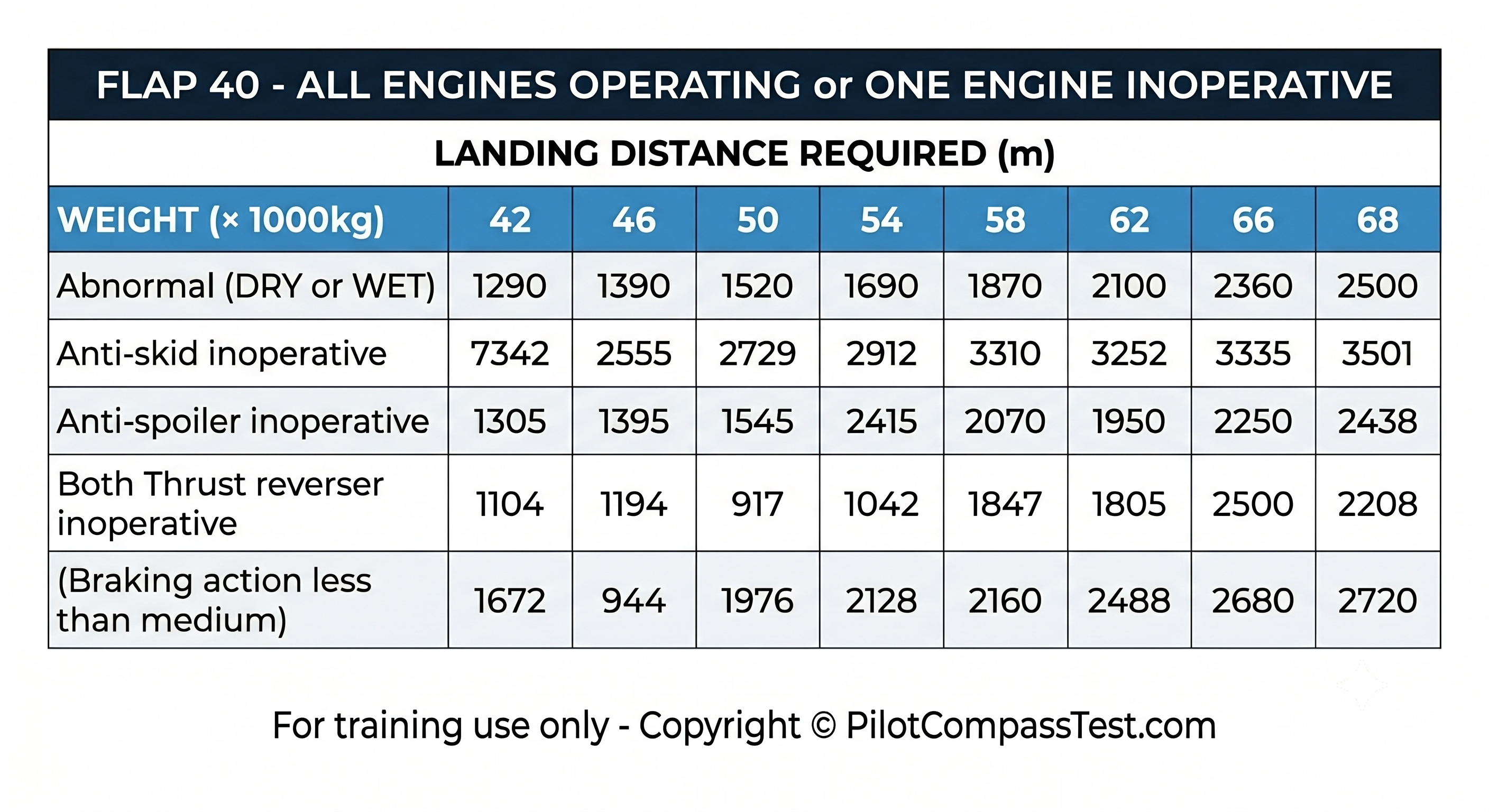
(Refer to table A) What is the landing distance required at 66000 kgs with flap 40 and the thrust reverser inoperative?
Answer: 2500
Step-by-Step Breakdown
- Read the chart carefully. Locate the specific row and column.
- Find the column for "Flap 40".
- Find the row/section for weight "66000 kgs".
- Apply the condition "Thrust reverser inoperative". Note any penalties or specific values.
- Read the intersecting value: 2500.
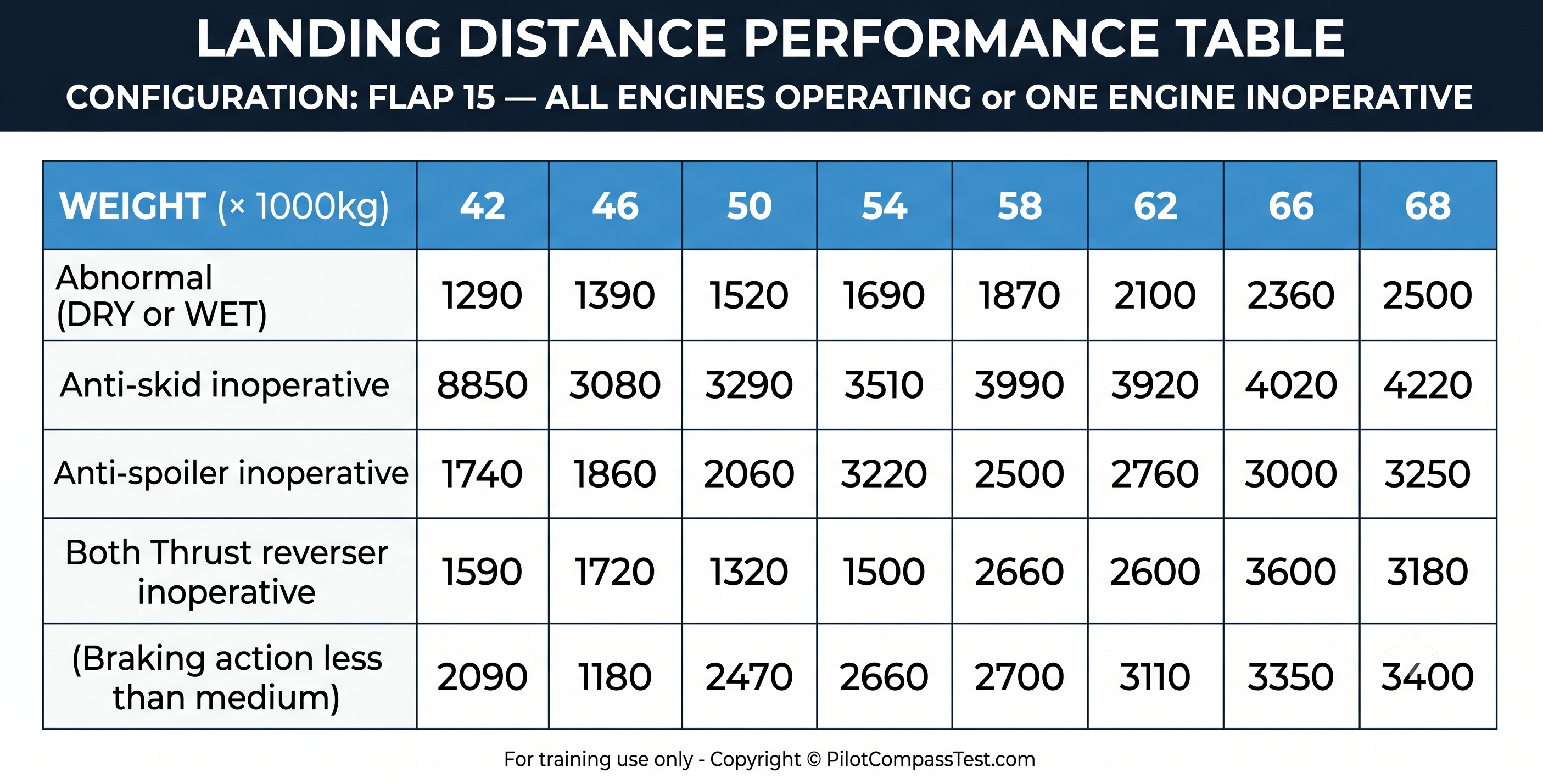
(Refer to table A) For a landing with flaps 15 and the anti spoiler inoperative what is the weight for landing on 1860 m runway?
Answer: 46000
Step-by-Step Breakdown
- Work backwards from the chart.
- Locate the landing distance "1860 m" under the "Flaps 15" setting with "Anti spoiler inoperative" conditions.
- Trace the row back to the corresponding weight on the left-hand axis.
- The intersecting weight is 46000 kgs.
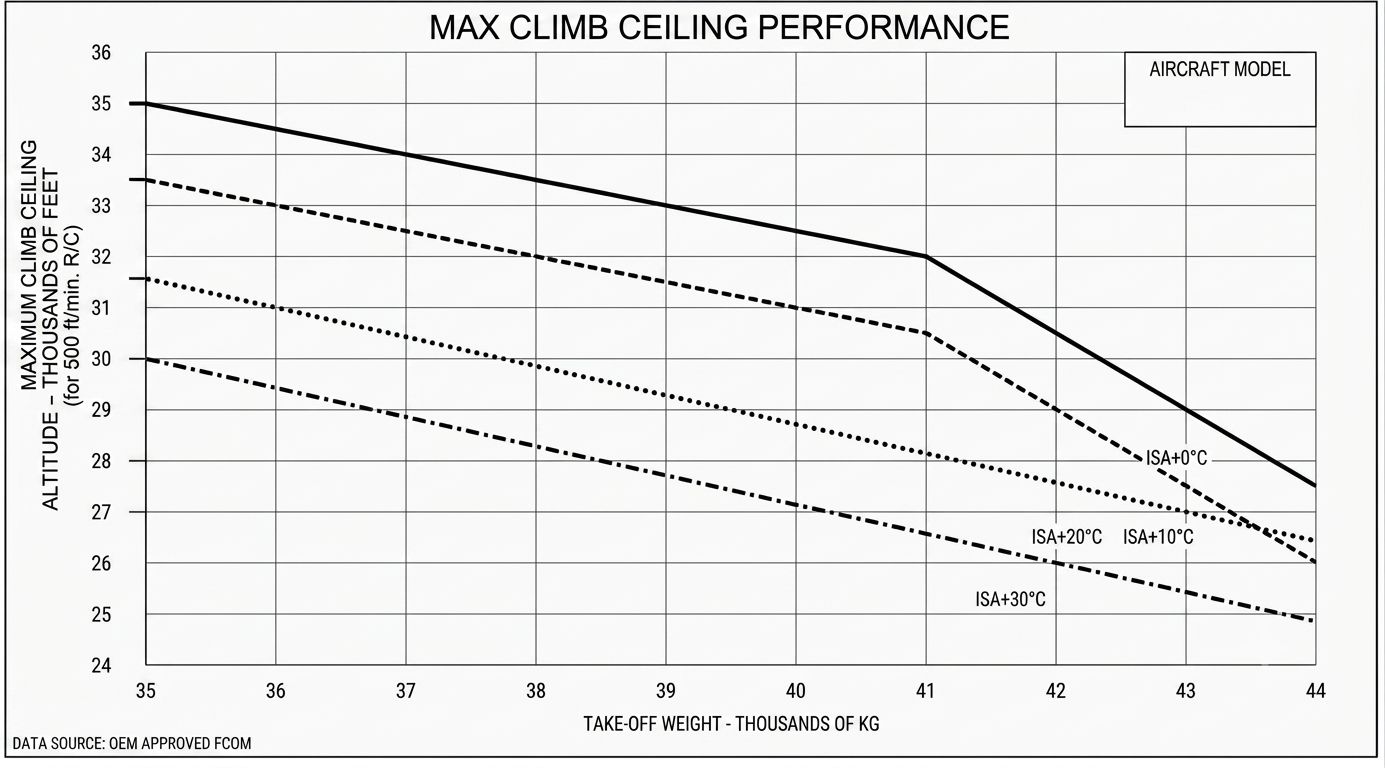
(Refer to graph B) What is the 500 ft/min rate of climb ceiling at ISA + 20 for a take-off weight of 39500 kgs?
Answer: 29000
Step-by-Step Breakdown
- Trace the values on the graph.
- Start at the X-axis (or relevant axis) for the weight "39500 kgs".
- Move vertically to the curve representing "ISA + 20".
- Move horizontally from that point to read the ceiling altitude on the Y-axis.
- The value reads 29000 ft.
(Refer to graph B) An aircraft is to fly at its 500 ft/min of climb at 32000 ft. At ISA what will be its take-off weight?
Answer: 41000
Step-by-Step Breakdown
- Read the graph in reverse.
- Start at the Y-axis for altitude "32000 ft".
- Move horizontally to intersect the curve for standard "ISA".
- Move vertically down to read the weight on the X-axis.
- The weight value is 41000 kgs.
An aircraft flies at a constant speed for 40 minutes due south and then for 40 minutes due east. Assuming there is no wind what will be the aircraft's compass heading to return to its starting point?
Answer: 315
Step-by-Step Breakdown
- Draw the path mentally. South (180°) then East (090°).
- Because it flies for the same amount of time at a constant speed, the two legs form an isosceles right triangle.
- The starting point is to the North-West of the current position.
- North-West heading is exactly between North (360) and West (270).
- Heading: 360 - 45 = 315 degrees.
An aircraft uses fuel at 45kg / minute while waiting to land. It has 2000kg of fuel in the fuel tanks. 650kg is needed for the landing. For how many minutes can the aircraft wait before landing?
Answer: 30
Step-by-Step Breakdown
- Calculate the available holding fuel. Total fuel minus landing fuel.
- 2000kg - 650kg = 1350kg available for waiting.
- Calculate the time. Time = Fuel / Burn Rate.
- 1350 / 45
- Shortcut: 1350 / 45 = (1350 / 9) / 5 = 150 / 5 = 30 minutes.
An aircraft takes off from airport A at 2130 GMT and lands at airport B at 0415 GMT. What is the total flight time in minutes?
Answer: 405
Step-by-Step Breakdown
- Calculate time to midnight. From 21:30 to 24:00 (midnight) is 2 hours and 30 minutes.
- Calculate time after midnight. From 00:00 to 04:15 is 4 hours and 15 minutes.
- Total time in hours and minutes. 2h 30m + 4h 15m = 6 hours 45 minutes.
- Convert to minutes. (6 x 60) + 45 = 360 + 45 = 405 minutes.
Two aircraft take off from A and B at 0900 hrs and fly directly towards each other. The aircraft from A flies at 150 km/hr and the aircraft from B at 250 km/hr. If the distance from A to B is 800 km how many km from A will they be when they meet?
Answer: 300
Step-by-Step Breakdown
- Find the relative closing speed. Because they fly towards each other, add their speeds.
- 150 + 250 = 400 km/hr.
- Find the time until they meet. Time = Distance / Speed.
- 800 km / 400 km/hr = 2 hours.
- Find distance from A. Multiply aircraft A's speed by the time.
- 150 km/hr x 2 hours = 300 km.
An aircraft flies for 1200 km at a speed of 300 mph. One mile = 8/5 km. How many MINUTES will it take to fly the 1200 kms?
Answer: 150
Step-by-Step Breakdown
- Convert distance to miles. 1 mile = 8/5 (1.6) km.
- Miles = 1200 / (8/5) = 1200 x 5 / 8.
- 1200 / 8 = 150. 150 x 5 = 750 miles.
- Calculate time in hours. Time = Distance / Speed.
- 750 miles / 300 mph = 2.5 hours.
- Convert hours to minutes. 2.5 x 60 = 150 minutes.
At 32 degrees F a centigrade thermometer will read 0 degrees C. 1 degree F = 32+9/5 degrees C What will a centigrade thermometer read at 77 degrees F?
Answer: 25
Step-by-Step Breakdown
- Understand the conversion formula. C = (F - 32) x 5/9.
- Substitute F with 77.
- 77 - 32 = 45
- Multiply by 5/9.
- 45 x 5 / 9 = (45 / 9) x 5 = 5 x 5 = 25 degrees Celsius.